

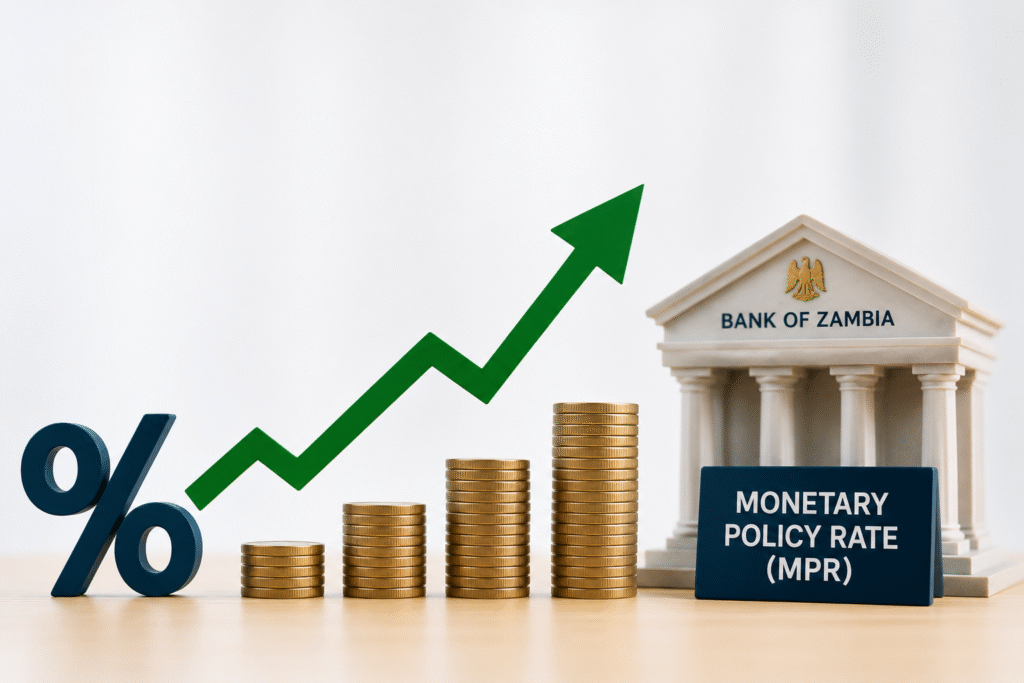
The recent increase in Zambia’s Monetary Policy Rate (MPR) has affected borrowers, savers, investors, and businesses across the country. But what does this actually mean for your financial life?
Whether you are repaying a loan, saving for the future, investing in bonds, or trying to build wealth, understanding the Monetary Policy Rate is essential for making informed financial decisions.
In this article, we break down what the MPR is, why the Bank of Zambia adjusts it, and how these changes affect loans, investments, savings, and the broader economy.
Interest rates affect almost every part of your financial life — from the cost of borrowing to the returns you earn on your investments.
What Is the Monetary Policy Rate (MPR)?
The Monetary Policy Rate (MPR) is the benchmark interest rate set by the Bank of Zambia (BoZ).
It is one of the BoZ’s most important tools for influencing borrowing costs, money supply, inflation, and overall economic activity.
When the MPR increases, commercial banks usually increase lending rates, making loans more expensive for consumers and businesses.
In theory, higher MPR should also lead to higher savings and deposit rates. However, in Zambia, banks often increase loan interest rates much faster than they increase deposit rates for savers.
Key Takeaways About the MPR
- The MPR influences loan interest rates across the banking sector.
- Higher MPR usually means higher borrowing costs.
- The MPR can also affect bond yields, savings returns, and investment decisions.
- Inflation and exchange rate stability are major reasons the Bank of Zambia adjusts the MPR.
Why Does the Bank of Zambia Increase the MPR?
The Bank of Zambia adjusts the Monetary Policy Rate to address economic challenges and maintain stability within the financial system.
There are three major reasons the BoZ may decide to increase interest rates.
Why the BoZ Raises the MPR
| Objective | Why It Matters |
|---|---|
| Control Inflation | Higher interest rates help reduce excess money supply and slow rising prices. |
| Attract Foreign Investment | Higher yields can attract foreign capital into government securities and financial markets. |
| Promote Economic Stability | Stable inflation and currency conditions help support long-term economic growth. |
The Challenge Zambia Faces
One of Zambia’s biggest economic challenges is that inflation is often driven by external and structural factors that interest rates alone cannot fully control.
These include:
- Rising fuel prices
- Exchange rate pressure
- Supply chain disruptions
- Climate-related challenges such as droughts
- Rising food prices
This makes monetary policy more complex because increasing interest rates may slow borrowing, but it cannot directly solve all inflationary pressures.
How the MPR Increase Affects Borrowers
For many Zambians, the most immediate impact of an MPR increase is higher loan repayments.
Most loans in Zambia are linked to variable interest rates. This means that when the MPR rises, commercial banks often increase lending rates as well.
This affects:
- Personal loans
- Business loans
- Vehicle financing
- Mortgages
- Working capital facilities
Consider increasing your repayments slightly above the minimum installment to reduce your loan balance faster and lower your total interest costs over time.
What Borrowers Can Do
- Increase monthly repayments where possible
- Review refinancing options with your bank
- Reduce unnecessary debt exposure
- Focus on cash flow management
- Prioritize high-interest debt repayment
Some borrowers may also consider renegotiating loan terms to ease monthly pressure, though longer loan periods usually increase the total interest paid over time.
How the MPR Increase Affects Savers and Investors
The impact of the MPR increase on investors depends on the type of investment involved.
Some investments benefit from higher interest rates, while others may come under pressure.
Impact of Higher MPR on Investments
| Investment Type | Possible Impact |
|---|---|
| Savings Accounts | Deposit rates may rise slowly, although often not as quickly as lending rates. |
| Money Market Funds | Usually benefit from higher short-term interest rates. |
| Government Bonds | New bond issues may offer higher yields. |
| Shares / Equities | Some companies may struggle with higher borrowing costs. |
| Real Estate | Higher mortgage rates may reduce property demand. |
Government Bonds Become More Attractive
One of the most important effects of rising interest rates is the potential increase in government bond yields.
As rates rise, newly issued GRZ bonds may offer stronger returns to attract investors.
This is why many investors closely monitor Monetary Policy Committee announcements and upcoming bond auctions.
During periods of high interest rates, government securities often become increasingly attractive relative to lower-yield savings products.
What About the Stock Market?
Higher interest rates can affect companies differently.
Businesses with high debt levels may struggle because borrowing becomes more expensive.
However, some sectors — particularly financial institutions — may benefit from wider lending margins and increased interest income.
This is why investors should always evaluate individual companies carefully rather than reacting emotionally to market headlines.
“Interest rate changes do not only affect borrowers. They reshape the entire investment landscape.”
How Investors Should Respond
Rising interest rates require investors to become more intentional and strategic.
This is a good time to:
- Review portfolio allocations
- Compare investment returns against inflation
- Explore government bond opportunities
- Strengthen emergency savings
- Reduce unnecessary financial risk
- Focus on long-term investment discipline
The key is not panic. The key is adaptation.
Watch the Full Discussion on YouTube
For a deeper explanation of how Zambia’s Monetary Policy Rate affects borrowers, savers, investors, and businesses, watch the full discussion below.
Final Thoughts
The Monetary Policy Rate affects almost every part of the economy — from loans and savings to investments and business decisions.
Borrowers face higher repayment pressure, while investors must rethink how to position their portfolios in a higher-interest-rate environment.
Staying informed and proactive is essential for making smarter financial decisions during periods of economic change.
Ready to Build a Smarter Investment Strategy?
Learn how interest rates, bonds, shares, and investment decisions work together inside the PATH Investing Framework™ and join our growing investor community.