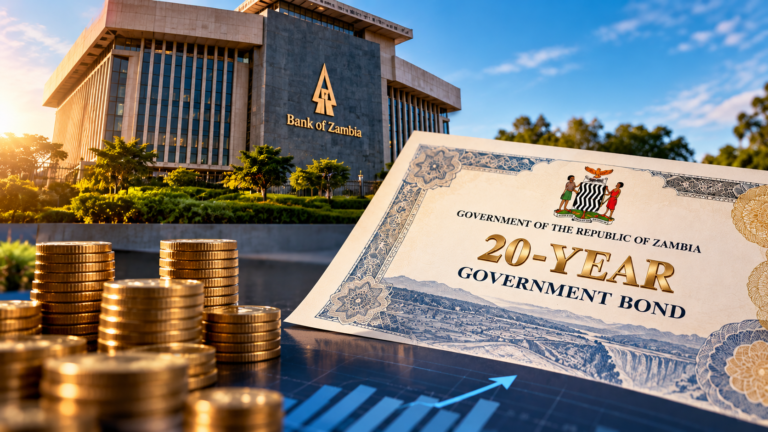


There is a particular kind of investor confidence that arrives the moment you receive your CSD statement. You applied. The auction results came in. Your bid was accepted. The Kwacha left your account, and in its place sits a government bond — a clean, numbered entry in the central securities depository, backed by the full faith of the Republic of Zambia.
You feel, quite reasonably, like you've done the hard part.
You haven't.
The allocation is the beginning of the investment, not the end of it. What happens between the day you buy and the day the bond matures — how you track it, interpret it, and respond to the market around it — is precisely what separates a passive savings decision from an active investment strategy. Most Zambian retail investors never think about this distinction. And that gap is costing them.
This article is about what intelligent bond investors track. Not obsessively. Not every hour. But deliberately, with a system, and with a clear understanding of why each data point matters to their portfolio.
Why Buying the Bond Is Only the Beginning
The PATH Investing Framework™ — Prepare, Allocate, Track, Harvest — places enormous weight on that third letter. Tracking is where the work of investing actually lives. Allocation gets you into the market. Tracking is what keeps you intelligent while you're in it.
The misconception that bonds are "set and forget" is understandable. Unlike equities, bonds don't flash red and green on a screen every minute. They pay a predictable coupon. They mature on a known date. Nothing dramatic seems to happen. But the economic forces operating around your bond — interest rates, inflation, exchange rates, policy decisions — are moving constantly. And those forces change the real value of what you own, even if the nominal value never moves.
"A bond that pays 16% looks very different when inflation is 11% versus when inflation is 6.8%. The coupon hasn't changed. Your real return has."
Zambia's bond market in 2026 is not the market of three years ago. The macro environment has shifted dramatically. Inflation, which sat at 11.2% as recently as December 2025, has fallen to 6.8% as of April 2026 — entering the Bank of Zambia's target range of 6–8% for the first time since 2019. The policy rate has been cut three times in quick succession, from 14.25% in November 2025 to 13.25% in May 2026. Benchmark bond structures have been reformed. Foreign investor participation caps were raised from 5% to 23% in January 2026. Record oversubscription followed — with February's auction drawing over K21 billion in bids against a K4.2 billion target, the largest in Zambia's history.
All of this matters to you as a bondholder. Here is why — and what you should do about it.
What Smart Bond Investors Actually Track
This is the most fundamental relationship in fixed income investing: when interest rates fall, existing bond prices rise. When rates rise, existing bond prices fall. It's an inverse relationship, and in Zambia's current easing cycle, it has very specific implications.
If you hold a 10-year GRZ bond with a coupon of 17.59% — the rate available at the February 2026 auction — and yields continue their downward trend toward the 16.6% range recorded in later auctions, the market value of your bond has increased. You locked in a rate that new buyers can no longer access. That is a paper gain you could potentially realise if you sell on the secondary market.
Track the yield offered at each new auction. Compare it to the coupon on your existing bond. The spread tells you whether you're holding a premium bond (yours pays more than new issuances) or whether the market has moved against you. This isn't academic — it directly informs whether holding to maturity remains the best decision for your portfolio, or whether selling in the secondary market at a premium could deliver better outcomes.
The Bank of Zambia's Monetary Policy Committee meets every quarter. Their decisions on the policy rate set the direction of the entire yield curve. In the current cycle, the committee has been cutting rates — 75 basis points in February, another 25 in May 2026 — and markets are pricing in further easing as inflation converges to target.
Every investor with Zambian government bonds should mark their calendar for MPC announcement dates. Not to trade nervously, but to understand the macro direction. A rate cut means new bonds will be issued at lower yields, increasing the relative value of what you already hold. A rate hold or a surprise hike changes that calculus entirely.
The BOZ Governor's post-MPC press briefings are publicly available and accessible to all investors. Read them. They contain forward guidance on inflation, exchange rate outlooks, and the committee's risk assessment — all of which affect the trajectory of yields on your bond.
This is where many investors deceive themselves without realising it. A 16% coupon sounds excellent. But the question that matters is: 16% relative to what?
The real return on a Zambian government bond is calculated using the Fisher equation: Real Return = ((1 + Nominal Yield) ÷ (1 + Inflation Rate)) − 1. Additionally, bond income in Zambia is subject to 20% withholding tax, further reducing the effective yield.
Running the full calculation for a 10-year bond at 16.6% nominal yield, with 20% WHT and 6.8% inflation: your real after-tax return is approximately 6.9%. Comfortable — but far less breathtaking than the headline number suggests, and worth knowing precisely.
Chanda invested K200,000 in a 10-year bond at 16.6% in early 2026. Her annual coupon income before tax is K33,200. After 20% WHT, she receives K26,560. With April 2026 inflation at 6.8%, K26,560 in 2027 has the purchasing power of approximately K24,869 in today's terms.
This is still a strong return. But Chanda should track inflation quarterly. If inflation surprises to the upside — say, if food prices spike due to a drought reversal — her real return compresses. If inflation falls further to 6%, her real return improves. Neither happens without consequence.
GRZ bonds pay coupons semi-annually — every six months from the issue date. This sounds simple, but many retail investors are genuinely surprised when their coupon arrives and uncertain about what to do with it.
Know your payment dates precisely. Track them in your calendar. When the funds arrive in your account, the question is not "great, money" — the question is "what does this coupon now buy me?" In a falling yield environment, every coupon you receive is an opportunity to reinvest at whatever rates are available in the next auction. The yields available today may not be available in six months. That is the reinvestment risk embedded in every bond.
Sophisticated bond investors don't just collect coupons. They have a plan for them. The coupon is not the end of the return — it is an opportunity to compound it.
In Zambia's current environment, where T-bill yields sit around 11.45% at the 91-day tenor and bond yields are declining, the optimal reinvestment choice depends on your time horizon, tax situation, and market outlook. A 91-day T-bill is liquid and accessible with minimum bids starting at K1,000. A longer-dated bond locks in today's still-elevated yield for years. Treasury bills and bonds are not competing products — they can work together in a laddered strategy that keeps your portfolio both liquid and yield-optimised.
"The bond ladder isn't just a metaphor. It's a system that ensures some portion of your portfolio is always maturing, always giving you the opportunity to reinvest at prevailing rates."
Are all your investable assets in a single bond tenor? That is a risk that doesn't announce itself until it's too late. Concentration in a single maturity bucket means your entire portfolio reprices at once — either as a windfall or as a loss, depending on the direction of rates at that moment.
Deliberately diversify across tenors. Hold some 2-year and 3-year bonds for shorter-cycle liquidity, some 7-year and 10-year for higher coupon income, and consider the 15-year only if your investment horizon genuinely matches the maturity. Check your allocation quarterly and ask: if rates moved 200 basis points in either direction, which part of this portfolio would suffer most?
GRZ bonds cannot be redeemed early at the Bank of Zambia. If you need K500,000 in three years and it is locked in a 10-year bond, you must either wait or sell in the secondary market at whatever price a willing buyer offers. In Zambia's secondary market, that buyer may not always be easy to find at short notice — and the price may not reflect your expectations.
Before investing in any bond tenor, map your expected cash needs against your investment timeline. Reserve enough in liquid instruments — savings, T-bills, money market funds — to cover your horizon-1 and horizon-2 needs without touching the bond portfolio. Then let the bond portfolio compound undisturbed.
The LuSE-administered secondary market for GRZ bonds exists and is functional, though thin by the standards of more mature markets. Knowing this market exists matters for two reasons: first, it gives you an exit if your circumstances change unexpectedly; second, it creates opportunity when you know what you're looking at.
When yields at primary auction fall sharply — as they did from the February highs to the April 2026 lows — investors holding higher-coupon bonds from earlier auctions are holding instruments that trade at a premium in the secondary market. That premium is a source of capital gain that many retail bondholders never think about, let alone act on.
At the April 2026 auction, the 7-year bond's cut-off yield was 15.80% — below its coupon rate of 16.00%. Investors paid a premium to buy it. If you acquired a 16.00% coupon bond at par value in an earlier auction, you now hold a bond that the market is valuing above face value.
Duration is the bond investor's sensitivity metric. It measures how much the price of your bond will change in response to a 1% move in interest rates. A 10-year bond has considerably more duration risk than a 2-year bond. In a falling rate environment, that's a feature — it amplifies your capital gains. In a rising rate environment, it's a liability.
In 2026, as Zambia continues its easing cycle, longer-duration bonds are likely to appreciate further in market value. But investors should understand that duration cuts both ways. If global conditions shift, if the fiscal picture deteriorates, or if inflation reverses sharply, the same long-duration bonds that are winners today could become sources of unrealised losses tomorrow.
Know the duration of what you hold. Adjust your mix as your view of the rate cycle evolves.
This is the factor most retail investors in Zambia have never thought to track — and it may be the most structurally consequential development in the bond market in years.
In January 2026, the Bank of Zambia raised the cap on non-resident ownership of government securities from 5% to 23%. The impact was immediate and dramatic. February's auction drew K21.3 billion in bids — more than five times the amount offered, with foreign participation hitting 23% for the second consecutive month. The 10-year bond attracted K4.287 billion in bids on a K600 million offer. The 15-year drew K8.824 billion against K560 million on offer.
Foreign capital is now a significant force in Zambia's bond market. It compresses yields — because more demand for a fixed supply means buyers accept lower returns. For existing bondholders, that's excellent news: your bonds appreciate. But there is a risk on the other side of this trade. Foreign "hot money" can exit quickly when global risk sentiment shifts. Yields in Zambia's secondary market could spike sharply if foreign investors withdraw en masse, driven by dollar strength, commodity shocks, or emerging market risk aversion.
Smart investors track non-resident participation figures when they appear in BOZ auction results and central bank reports. A sudden decline in foreign participation is an early warning signal worth understanding.
Zambia's Bond Market Is Changing — And That Changes What You Should Watch
The structural transformation of Zambia's government securities market in 2026 is not a footnote. It is the context inside which every tracking decision you make now lives.
Three developments demand attention from any serious retail bondholder.
Falling yields across the curve. The 10-year bond, which reached an all-time high yield of 38% in late 2020 during the debt crisis, is now at approximately 17%. That trajectory — downward, steadily — tells a story about restored market confidence, successful debt restructuring negotiations, and improving macroeconomic fundamentals. But it also tells a story about declining forward returns. The investor who bought in 2022 or 2023 at 30%+ yields made a generational trade. The investor buying today is working with a very different return profile.
Benchmark bond reforms. The BOZ's March 31, 2026 announcement restructured the entire maturity profile of the market. The 5-year bond — once a workhorse of retail bond laddering strategies — was suspended, as confirmed by its absence from the April 2026 auction with the explicit explanation that it was being removed to "realign the Government securities maturity profile in the medium term." The new benchmark designations elevate the 7-year and 15-year tenors. Auction frequency has shifted to twice per quarter. For the investor who built a strategy around quarterly 5-year bond reinvestments, this is a material change requiring portfolio rethinking, not passive acceptance.
Increased market sophistication. The dramatic under-subscription at the April 2026 auction's long end — where only 1.7% of the K1.575 billion offered in the 7-year benchmark was allocated — showed that even large institutional investors were confused by the reformed structure. When the market is confused, prices become less predictable. That is both a risk and an opportunity for the retail investor who takes the time to understand the mechanics.
The Difference Between Watching Markets and Tracking Your Portfolio
These are not the same activity. They feel similar — both involve paying attention to financial information — but they serve fundamentally different purposes and produce fundamentally different results.
Watching markets is reactive. It is the investor who refreshes news feeds after MPC announcements, feels anxious when yields move, and makes portfolio decisions based on the last thing they read. This kind of investor is always slightly behind the information — responding to what has happened rather than positioning for what is coming.
Tracking your portfolio is proactive. It asks specific questions about a specific set of investments, on a scheduled basis, against a predefined set of benchmarks. It is not driven by noise. It is driven by your personal financial goals, your investment timeline, and the metrics that actually affect your returns.
"The investor who panics when yields fall has confused market activity for portfolio management. Your job is not to respond to the market. Your job is to manage your position within it."
A classic behavioral error in bond investing is what behavioral finance calls "yield anchoring" — the tendency to evaluate current yields against the highest yield you ever saw, rather than against your actual return targets. An investor who bought bonds in 2022 at 28% may feel that today's 17% is "too low" and delay reinvesting maturing proceeds. But 17% nominal — after adjusting for current inflation of 6.8% and WHT — may well deliver a real return superior to what a less disciplined alternative would produce. The relevant comparison is not yesterday's exceptional yield. It is today's available options against today's conditions.
The tracking framework that follows is designed to break this pattern and replace it with something more structured and useful.
A Practical Bond Tracking System for Retail Investors
This is not a complicated system. It does not require a Bloomberg terminal or a finance degree. It requires discipline, a spreadsheet, and about thirty minutes per quarter.
| Tracking Area | What to Check | How Often | Where to Find It |
|---|---|---|---|
| Bond yields | Yields at latest primary auction vs your coupon rates | After each auction (twice per quarter) | BOZ website: boz.zm → Markets & Securities |
| Inflation | CPI figure vs your coupon — recalculate real return | Monthly | ZamStats / BOZ press releases |
| BOZ policy rate | Policy rate direction and MPC forward guidance | Quarterly (each MPC meeting) | BOZ MPC press briefings |
| Coupon receipts | Confirm coupon received on schedule; plan reinvestment | Semi-annually per bond | Your bank account / CSD statement |
| Reinvestment plan | Best available instrument for coupon proceeds | On each coupon receipt | T-bill tender results; next bond auction |
| Portfolio concentration | Allocation by tenor; liquidity buffer adequacy | Quarterly | Your spreadsheet / CSD portfolio view |
| Foreign participation | Non-resident bid share in latest auction | After each auction | BOZ auction press results (boz.zm) |
| Market structure | Any changes to benchmark designations or auction rules | Each BOZ public notice | BOZ press releases; Insight Partners Africa blog |
| Real return calculation | Recalculate after-tax, after-inflation return quarterly | Quarterly | Fisher equation: use updated CPI and WHT rate |
Quarterly Bond Portfolio Review Checklist
- What is the current BOZ policy rate, and has it changed since my last review?
- What yields were achieved at the most recent primary auction, and how do they compare to my holdings?
- What is the latest CPI figure? What is my real after-tax return at current inflation?
- Have I received all coupon payments on schedule? Are they accounted for?
- Do I have a plan for reinvesting my next coupon, and have I evaluated current T-bill vs bond rates?
- Does my portfolio have excessive concentration in a single tenor or maturity bucket?
- Do I have adequate liquid reserves outside my bond portfolio for horizon-1 needs?
- Are there any BOZ structural announcements that affect my bond ladder strategy?
- Have foreign participation trends shifted in recent auctions? What does that signal?
- What is my net position — am I on track to meet the financial goals this investment was built for?
Mutale holds three GRZ bonds: a 3-year bond at 14.5% (maturing in 8 months), a 7-year bond at 15.80% purchased in April 2026, and a 10-year bond at 17.19% purchased in January 2026.
At her June 2026 quarterly review, she notes: (a) the policy rate has been cut again to 13.25%; (b) inflation is at 6.8%, giving her best bond a real after-tax return of roughly 7%; (c) the 3-year bond is maturing soon — she needs to decide whether to roll it into a new bond or deploy elsewhere; (d) the 5-year bond tenor is suspended, eliminating a tool she previously used for laddering.
Because she tracks, Mutale can make this decision in 30 minutes. She doesn't need to panic, guess, or ask around. She has the data. She has the framework. She makes the call.
A Final Word
Zambia is in the early stages of a meaningful bond market transformation. The debt crisis of 2020–2023 has receded. Foreign investors have returned. Yields are falling from extraordinary highs to historically normal ranges. The structural architecture of the market — benchmark bonds, auction frequency, par-value pricing — has been modernised. Gross international reserves have hit a historic high of $6.5 billion. This is, by any reasonable measure, a compelling chapter for Zambian fixed income investors to be operating in.
But a compelling macro story is not a passive income strategy. It is an environment that rewards those who understand what they own, track the forces acting on it, and make deliberate decisions with their coupon income and their maturing proceeds.
The investor who bought the bond and filed the CSD statement is participating in this market. The investor who bought the bond and built a tracking system is profiting from it intelligently.
You did the right thing when you allocated to GRZ bonds. Now do the next right thing: stay informed, stay structured, and stay ahead.
That is what the T in PATH is for.
Ready to Invest With a Complete System?
The PATH Investing Framework™ training programme takes you through all four pillars — Prepare, Allocate, Track, and Harvest — with Zambia-specific tools, templates, and expert facilitation by Mukonki Mukonkela, FCCA, FZICA.
You Might Also Like
Continue exploring Zambia’s evolving government securities market, portfolio construction strategies, and investor education insights.
Why Zambia's New Benchmark Bond System Is Confusing Retail Investors — And What to Do About It
A deep dive into the March 2026 BOZ reforms: what changed, what was suspended, and what it means for your bond ladder.
How to Build a Bond Ladder in Zambia: A Step-by-Step Guide for Retail Investors
Why spreading your bonds across multiple maturities is the smartest way to manage reinvestment risk and liquidity in Zambia's market.
Nominal vs Real Returns: The Number Most Zambian Investors Ignore
How to calculate your true after-tax, after-inflation return on GRZ bonds — and why 16% isn't always what it looks like.
What Foreign Investors Entering Zambia's Bond Market Means for You
The impact of raising the non-resident participation cap from 5% to 23% — and what yield compression means for retail investors holding existing bonds.
From T-Bills to 15-Year Bonds: Which Tenor Is Right for Your Portfolio?
A practical guide to matching government securities to your investment horizon, liquidity needs, and risk profile in Zambia's 2026 market.
You Bought the Bond — Now What Should You Actually Track?
Smart investing does not end at allocation. Learn what experienced bond investors monitor after purchasing government securities.
Found this useful? Share it