
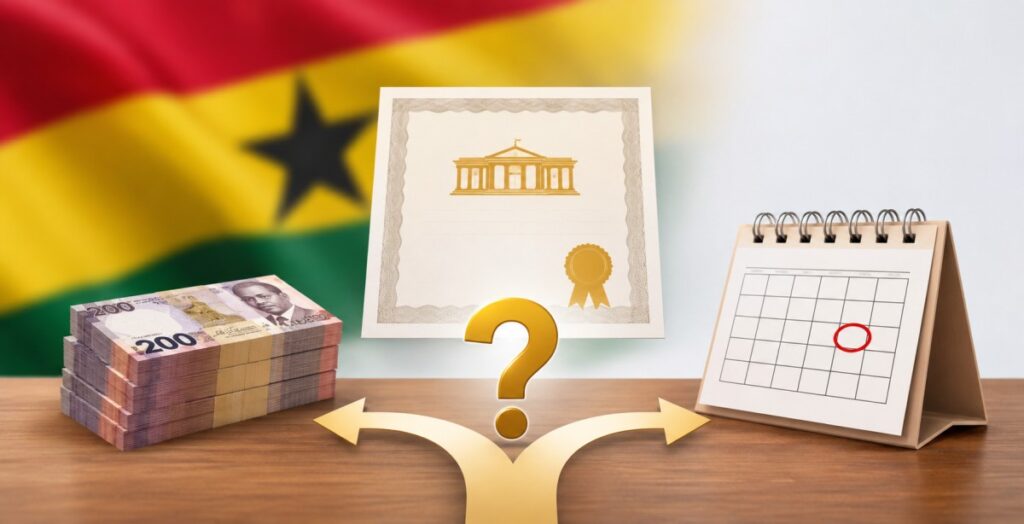
If you hold a Ghana Domestic Debt Exchange Programme (DDEP) bond due on 16 February 2027, compare two amounts before deciding whether to take the cash early. Work out what the tender proceeds could grow to by 16 February, then compare that with the principal and interest you expect on that date if you hold.
Would taking the cash early leave you better off?
Suppose your custodian quotes GH¢100,000 in net tender proceeds and estimates you would receive GH¢102,000 in principal and interest by holding to 16 February. Assume early settlement gives you 90 days to reinvest, and your replacement investment matures by 16 February. The amounts, timing and rates below are hypothetical.
| Choice | Calculation | Cash available |
|---|---|---|
| Tender and reinvest at 8% | GH¢100,000 + GH¢1,972.60 | GH¢101,972.60 |
| Tender and reinvest at 10% | GH¢100,000 + GH¢2,465.75 | GH¢102,465.75 |
| Hold the bond | Principal and interest at maturity | GH¢102,000.00 |
Using simple interest and a 365-day year, the break-even rate is about 8.11% annualised. You need GH¢2,000 on GH¢100,000 over 90 days, which is 2% for the period. Below that rate, holding produces more cash in this example if the bond pays as scheduled. Above it, tendering and reinvesting produces more if the replacement pays as assumed. The calculation assumes no extra taxes or fees on the replacement. Compare both choices after costs and account for any difference in credit risk.
What should you ask your broker or custodian?
- Does my bond qualify? Check the ISIN, the identifier on your bond statement. Ask for the official tender notice and the instructions for your holding.
- What lands in my account if I tender? Ask for the price per GH¢100 face value, whether accrued interest is paid separately or included, deductions, settlement date and what happens if only part of your tender is accepted.
- What would I receive if I hold? Get the principal and interest for your specific bond and the dates each amount is due. If a payment arrives before maturity, include its cash value on the comparison date.
- What can I earn before I need the money? Ask for the amount you actually pay for the replacement, its maturity date and what you expect back after costs. If you need the money before February, weigh earlier access alongside the return.
How do Treasury bills and longer bonds compare?
Reinvestment risk is the chance that the rate available when your cash comes back is lower than the rate you planned around. Shorter bills return your money sooner and expose you to the rate available at the next rollover. Longer bonds can give you a longer schedule of contractual payments, but selling early exposes you to price changes and a potentially thin market. A mix of maturities can spread the dates on which you need to reinvest.
Ghana offers 91-day, 182-day and 364-day Treasury bills. If you have exactly 90 days until a bill or expense is due, check the actual settlement and maturity dates before using a 91-day bill. Compare cash proceeds over the period you can invest. A bond coupon is based on face value, and a bill’s annualised rate does not tell you by itself how much cash the bill pays over its term. Bank of Ghana Treasury bill rates
Why Ghana’s borrowing plans matter for your next investment
The budget also sets out a plan to pay the US$590 million Eurobond obligation due on 2 January 2027 by 31 December 2026. Ghana estimates the two planned early payments at more than GH¢36 billion combined. The pre-budget fiscal strategy reported by 3News envisages no new Eurobonds through 2030 and Treasury bills falling to about 15% of domestic debt. Watch actual auction volumes and yields. Reinvested redemption cash could lift demand for new securities, while more issuance at longer maturities could increase supply. Either effect can vary by maturity. 2027 Budget Statement · 3News fiscal strategy coverage
The budget targets 5.2% growth, a 3.6% of GDP cash deficit, down from the 2026 target of 4%, and inflation within two percentage points of 8%. October inflation was 5.5% year on year. For your own decision, compare the yield available when you reinvest with the likely purchasing power of the proceeds when you need them. 2027 Budget Statement · Ghana Statistical Service
What Ghana and Zambia teach bondholders
Ghana’s 2023 domestic debt exchange changed coupons and payment dates for participating holders. Zambia’s 2024 exchange involved external Eurobonds. It replaced three old bonds with two that repay principal in instalments, with final maturities of 2033 and 2053 in the base case reported to the IMF. The practical lesson is to track the payment calendar for the specific security you own. When a restructuring or buyback changes that calendar, recalculate how much cash you expect, when it arrives and what it can earn until you need it. Ghana’s domestic exchange results · Zambia’s statement to the IMF
At the TRACK stage of the PATH Investing Framework, update your cash-flow calendar when your custodian confirms the terms. If you hold the bond through a fund or pension, ask the manager how early proceeds would affect its income and reinvestment plans. PATH Investing Framework