

Choosing a unit trust should not begin with the question,
“Which fund gave the highest return?”
The better question is:
Which fund is suitable for what I am trying to achieve?
Two unit trusts can both be legitimate investments and still be designed
for completely different purposes. One may focus on short-term liquidity,
while another may invest for long-term growth. To compare unit trusts only by their
recent returns can therefore lead to a poor investment decision.
Before you compare unit trusts in Zambia, start with your financial goal,
the amount you need, the time available, your need for access to the money
and the level of risk you can reasonably accept.
If you are still getting familiar with how these investments work,
start with our
Unit Trusts in Zambia guide
before comparing individual funds.
1. Start with the fund’s objective
Every unit trust should have an investment objective. This explains what
the fund is trying to achieve and usually gives an indication of the types
of investments it is permitted to hold.
A fund may, for example, focus on:
- preserving capital and providing liquidity;
- producing regular income;
- investing primarily in bonds;
- balancing income and growth;
- investing mainly in listed shares; or
- providing exposure to foreign-currency assets.
The fund’s objective should make sense for
your financial goal and time horizon.
If you are investing money you expect to need in six months, your
considerations will be very different from those of someone investing
for retirement in 20 years.
Start with the goal before choosing the investment product.
2. Find out what the fund actually owns
Do not judge a unit trust by its name alone.
Ask:
What investments are actually inside the portfolio?
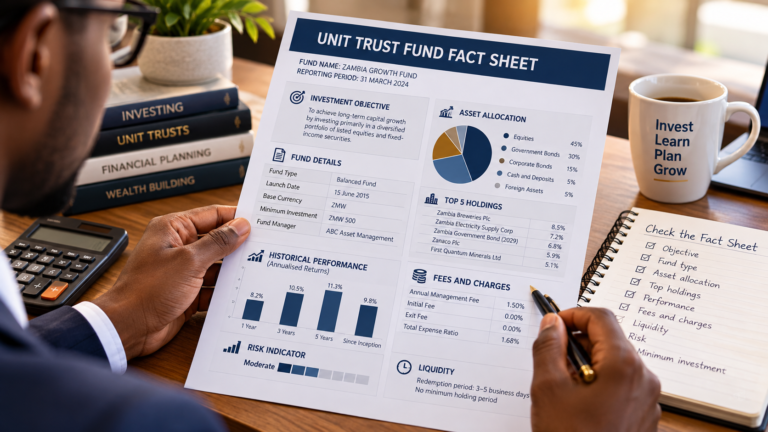
A fund factsheet may show holdings such as:
- Treasury bills;
- Government bonds;
- bank deposits;
- corporate debt;
- listed shares;
- cash; and
- foreign securities.
This matters because the underlying investments largely determine the
risk of the unit trust.
A money-market fund and an equity fund may both be unit trusts, but they
can behave very differently. Understanding the underlying assets helps
you understand what could cause the value of your investment to rise or fall.
3. Compare risk — not just returns
Higher historical returns do not automatically make a fund better.
Ask what risks were taken to produce those returns.
Important risks can include:
- market risk;
- interest-rate risk;
- credit risk;
- liquidity risk;
- currency risk; and
- inflation risk.
A fund that invests heavily in shares may experience larger movements in
value than a fund holding short-term money-market instruments.
Similarly, a bond fund can be affected by changes in market interest rates.
The appropriate level of risk depends on your goal, time horizon, ability
to tolerate losses and need for access to your money.
4. Understand every fee
Fees reduce the return that eventually reaches you.
Before investing, ask the fund manager to explain every charge clearly.
These may include:
- initial or entry fees;
- annual management fees;
- administration charges;
- advisory fees;
- exit or redemption charges; and
- transaction-related costs.
Do not compare funds only using the advertised investment return.
Compare what you are likely to receive
after relevant fees and charges.
A fee that looks small in percentage terms can make a meaningful
difference when an investment is held for many years.
5. Examine performance properly
Historical performance is useful, but it must be interpreted carefully.
Do not simply look for the fund with the biggest percentage return.
Ask:
- What period does the performance cover?
- Is the figure before or after fees?
- Is the return annualised or cumulative?
- How consistent has the performance been?
- What happened during difficult market periods?
- Has the fund’s investment strategy changed?
Also compare unit trusts of the same type with each other.
Comparing the return of a money-market fund with an equity fund may tell
you very little because the two investments may have completely different
objectives and levels of risk.
6. Check how easily you can withdraw
Liquidity matters.
Before investing, find out:
- how you request a withdrawal;
- how long payment normally takes;
- whether notice is required;
- whether there is a minimum holding period;
- whether partial withdrawals are permitted;
- whether exit charges apply; and
- what minimum balance must remain.
A fund can look attractive on paper but still be unsuitable if you cannot
access the money when your financial goal requires it.
This is particularly important when investing money intended for
shorter-term goals or emergencies.
7. Compare the fund manager as well as the fund
You are not simply buying a product. You are appointing a professional
organisation to manage part of your money.
Research the fund manager as well as the fund itself.
Look at:
- regulatory status;
- investment experience;
- quality of reporting;
- availability of current factsheets;
- transparency of fees;
- customer service;
- investment process; and
- consistency of communication.
Ask for documentation rather than relying only on marketing material.
A proper comparison should include both
the investment fund and the organisation managing it.
A simple checklist to compare unit trusts
Before investing, you should be able to answer the following questions.
| Question | What to establish |
|---|---|
| What is my goal? | Amount required and target date |
| What does the fund aim to do? | Investment objective |
| What does it invest in? | Underlying assets |
| What risks am I taking? | Main sources of potential loss or volatility |
| What will it cost? | All applicable fees and charges |
| How has it performed? | Relevant and comparable performance periods |
| Can I access my money? | Withdrawal rules, notice periods and settlement time |
| Who manages it? | Regulation, experience, reporting and transparency |
Do not compare unit trusts in isolation
If you are considering several funds, compare unit trusts using the same criteria.
Looking at one fund’s brochure and then another fund’s advertisement makes
comparison difficult because each provider may highlight different information.
Instead, create a simple comparison table and record the same information
for every fund you are considering.
| Criteria | Fund A | Fund B | Fund C |
|---|---|---|---|
| Fund type | |||
| Investment objective | |||
| Underlying assets | |||
| Minimum investment | |||
| Annual management fee | |||
| Withdrawal period | |||
| Historical performance | |||
| Main risks |
The final question: does the fund fit the goal?
The aim is not to find a fund that looks impressive in isolation.
The aim is to identify an investment whose characteristics are reasonably
aligned with what your money needs to accomplish.
That means the investment decision should come after planning, not before it.
The fund is a vehicle. The goal is the destination.
Continue learning about Unit Trusts
Learn how to compare Unit Trusts in practice
Join the next weekly Unit Trusts class and learn how to compare
fund types, fund managers, fees, risks, liquidity and performance
before making an investment decision.