

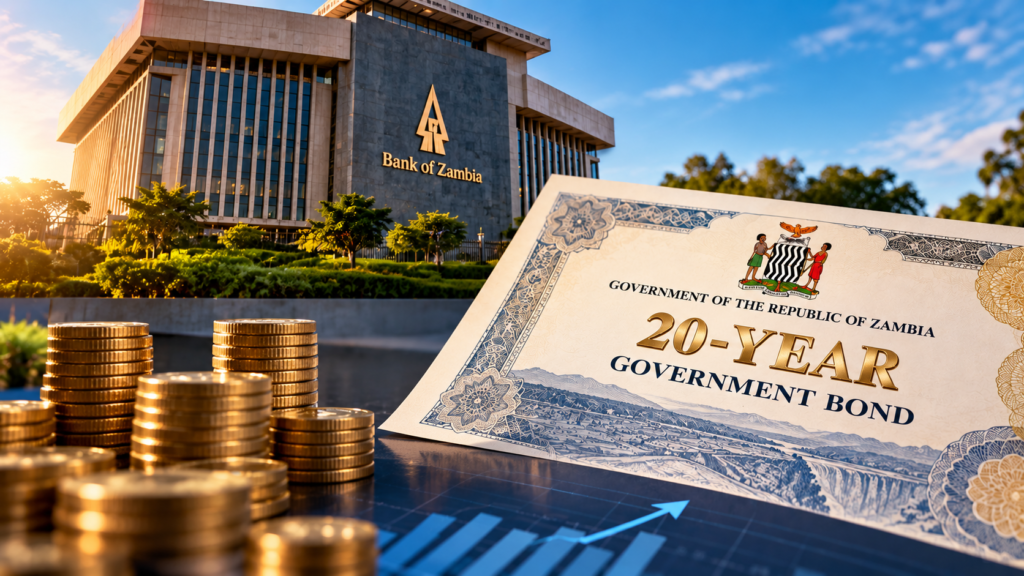
Bank of Zambia Introduces 20-Year Government Bond
The Bank of Zambia has announced the introduction of a
20-year Government of the Republic of Zambia bond,
extending Zambia’s domestic Government bond maturity range and creating
a new long-term investment option for the local capital market.
The new 20-year GRZ bond is expected to be offered as part
of the Government bond auction scheduled for
20 November 2026. It will also form part of Zambia’s
benchmark bond programme.
For investors, pension funds, insurers and other market participants,
the announcement is significant because Zambia’s Government securities
market has traditionally offered bonds with maturities ranging from
2 years to 15 years.
that will mature 20 years after issue. The coupon rate, final auction
yield and other pricing details should become clearer when the Bank of
Zambia publishes the relevant tender invitation and auction results.
Key Facts About Zambia’s 20-Year Government Bond
- Issuer: Government of the Republic of Zambia
- Fiscal agent: Bank of Zambia
- Maturity: 20 years
- Expected first auction: 20 November 2026
- Classification: Benchmark Government bond
- Purpose: To support longer-dated financial instruments and deepen Zambia’s domestic capital market
- Coupon/yield: Not yet confirmed in the initial announcement
What Is Zambia’s New 20-Year Government Bond?
A Government bond is a debt security through which investors lend money
to Government for an agreed period. In return, the investor normally
receives interest payments according to the bond terms and receives the
principal amount at maturity, subject to the applicable terms of issue.
The newly announced 20-year Zambia Government bond
represents Government borrowing with a maturity longer than the
traditional bond tenors currently available in Zambia’s domestic market.
The Bank of Zambia acts as fiscal agent for Government in issuing
Government securities. The new instrument is intended to support the
development and growth of longer-dated financial instruments within
Zambia’s capital market.
When Will the 20-Year GRZ Bond Be Issued?
The first 20-year Government bond is expected to feature in the
20 November 2026 Government bond auction.
Zambia’s fourth-quarter 2026 Government bond auction dates include:
- 20 November 2026
- 18 December 2026
The fourth-quarter issuance programme also provides for significant
Government bond issuance, making the November auction particularly
important for investors watching the launch of the new 20-year tenor.
Why Has Bank of Zambia Introduced a 20-Year Bond?
One of the main reasons is to extend Zambia’s domestic yield curve and
create a market for longer-term Government debt.
1. Longer-term investment opportunities
Pension funds, insurance companies and other institutional investors
often have long-term financial obligations. A 20-year bond provides
another investment instrument that can potentially help match those
long-term liabilities.
2. Development of Zambia’s capital market
A functioning market for longer-term bonds can help establish reference
interest rates for longer periods. These rates can eventually be useful
in pricing other long-term financial instruments.
3. Extending Zambia’s Government bond maturity range
Zambia’s domestic bond market has included maturities such as
2, 3, 5, 7, 10 and 15 years. The introduction of a
20-year Government bond extends that maturity range.
What Does Benchmark Bond Mean?
The Bank of Zambia has been implementing reforms intended to concentrate
Government securities issuance into selected benchmark bonds.
In 2026, the Bank designated selected longer-term Government securities
as benchmark bonds. The new 20-year bond is expected to form part of that
benchmark programme.
A benchmark bond is generally an actively issued Government security
intended to build sufficient outstanding volume to improve trading,
price discovery and market liquidity.
How Does the 20-Year Bond Compare With Other GRZ Bonds?
| Bond Tenor | General Characteristic | Interest-Rate Sensitivity |
|---|---|---|
| 2–3 years | Shorter maturity | Generally lower price sensitivity |
| 5–7 years | Medium-term Government borrowing | Moderate interest-rate sensitivity |
| 10–15 years | Long-term Government borrowing | Higher sensitivity to changes in market yields |
| 20 years | Very long-term Government borrowing | Greater potential price sensitivity if sold before maturity |
Does a 20-Year Bond Lock Your Money Away for 20 Years?
Not necessarily.
Government bonds may be bought and sold in the secondary market before
maturity. However, selling before maturity introduces
market-price risk.
If market yields rise after an investor buys the bond, the market price
of the existing bond may fall. If market yields decline, the value of an
existing bond may rise, depending on its coupon and remaining maturity.
Because a 20-year bond has a very long maturity, changes in interest
rates can have a larger effect on its market value than on a shorter-term
bond.
What Will the Interest Rate on the 20-Year Bond Be?
At the time of writing, the final
coupon rate and auction yield have not yet been confirmed.
Investors should distinguish between the bond’s coupon rate and its
auction yield.
The coupon rate is the stated interest rate attached to
the bond. The yield reflects the return implied by the
price at which the investor purchases the bond and the bond’s future cash
flows.
Investors should therefore review the official Bank of Zambia tender
invitation and auction results when they are published.
What Should Investors Consider Before Buying?
- Investment goal: What is the money intended to achieve?
- Time horizon: When will the money be needed?
- Auction yield: How does the return compare with other Government bonds?
- Inflation risk: How could inflation affect purchasing power over 20 years?
- Interest-rate risk: Could the bond lose value if sold before maturity?
- Liquidity: How easily could the bond be sold in the secondary market?
- Diversification: What role would the bond play in the investor’s wider portfolio?
Why Interest-Rate Risk Matters More on a 20-Year Bond
Bond prices and market interest rates generally move in opposite
directions.
If interest rates rise substantially after an investor purchases a
long-term bond, newly issued securities may offer higher yields.
An older bond paying a lower rate may therefore trade at a lower price.
The longer the remaining maturity of a bond, the more significant this
price effect can become.
What Does the 20-Year Bond Mean for Zambia’s Capital Market?
The introduction of a 20-year Government bond is more than the addition
of another investment product.
It potentially establishes a new reference point at the long end of
Zambia’s domestic interest-rate curve.
If sufficient volumes are issued and actively traded, the bond could
contribute to better long-term price discovery and support the
development of other long-term financial instruments.
How Can Individual Investors Buy GRZ Bonds?
Individual investors can participate in Zambia’s Government securities
market using the procedures and authorised channels applicable to Bank
of Zambia Government securities.
Before investing, it is useful to understand how Government bond auctions
work, how bond yields are calculated and how to interpret auction results.
Read:
How to Read the Bank of Zambia Bond Auction Results
.
You can also visit our
Investment Vehicles
hub for more information about Government bonds, shares and unit trusts.
What Should Investors Watch on 20 November 2026?
- The coupon rate
- The amount offered
- Total bids received
- Total amount allotted
- The auction yield
- Demand for the 20-year maturity
- How its yield compares with the 10-year and 15-year Government bonds
These figures will give investors an early indication of how the market
is pricing very long-term Zambian Government debt.
Frequently Asked Questions
Has Zambia introduced a 20-year Government bond?
Yes. The Bank of Zambia announced the introduction of a 20-year
Government bond in October 2026.
When will Zambia’s 20-year bond be issued?
The first issue is expected at the Government bond auction scheduled
for 20 November 2026.
What is the interest rate on the 20-year GRZ bond?
The final coupon and auction yield have not yet been confirmed.
Investors should check the official Bank of Zambia tender invitation
and auction results when published.
Is the 20-year GRZ bond a benchmark bond?
Yes. The new security is expected to form part of Zambia’s benchmark
Government bond programme.
Do investors have to hold the bond for 20 years?
Not necessarily. Government bonds can generally be traded before
maturity, although their market price may be higher or lower than the
original purchase price.
Insight Partners Africa View
The introduction of Zambia’s 20-year Government bond is an important
development in the evolution of the domestic Government securities
market.
However, the existence of a new investment instrument does not
automatically mean it is suitable for every investor.
Investors should begin with their financial goal, time horizon, required
return, liquidity needs and overall portfolio before selecting an
investment vehicle.
Investments are vehicles; goals are destinations.
Learn More About Investing in Zambia
Explore practical investment education on Government bonds, shares,
unit trusts and other investment vehicles.
Disclaimer: This article is for financial education and
general information only. It does not constitute personalised investment
advice, an offer to buy or sell securities, or a recommendation to invest
in any particular security.